“Two things moving together does not mean one is causing the other.”
Post hoc ergo propter hoc (“after this, therefore because of this”) ·
Cum hoc ergo propter hoc (“with this, therefore because of this”) ·
The Correlation Fallacy · Spurious Correlation · Confounding
Unlike most entries in this series, “Correlation Is Not Causation” belongs to no single person. It’s a foundational principle woven across statistics, logic, philosophy, and science — recognized so long ago that the formal name is Latin. Post hoc ergo propter hoc: “after this, therefore because of this.” The rooster crows, the sun rises. The rooster caused it. This is one of the oldest identified reasoning errors in recorded thought.
The principle is simple to state and extraordinarily easy to violate. Humans are pattern-recognition machines by nature — we are wired to find cause in sequence and coincidence. That wiring built civilization. It also generates enormous quantities of confident nonsense, most of which never gets corrected because it feels true.
The Three Reasons Any Correlation Exists
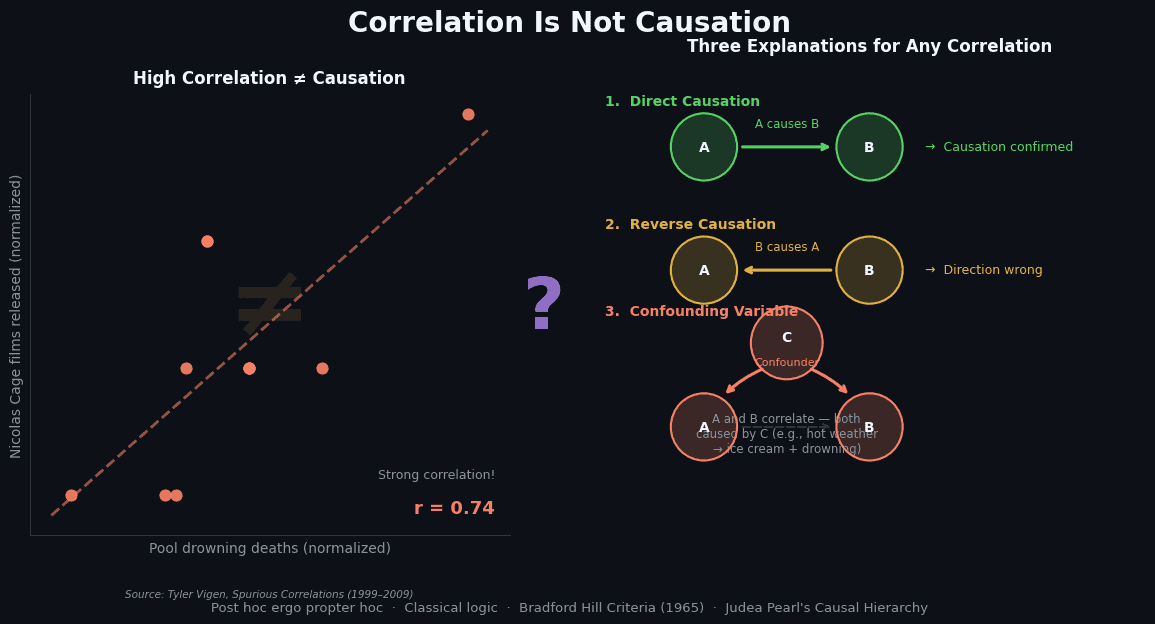
When A and B move together, there are exactly three structural explanations. Every legitimate causal investigation must rule out the other two before declaring the third:
A directly causes B. The relationship is real and directional. This is what we usually assume — and the least automatic thing to prove.
Reverse causation. The arrow points the other way. More police in high-crime areas looks like “police cause crime” unless you check the direction.
A third variable causes both. Hot weather causes both ice cream sales and drowning. Neither causes the other. C is the confounder.
Where You’ll See It
- Ice cream and drowning: Both spike in summer. Hot weather drives both. Banning ice cream would not save lives at the pool — but a naive reading of the correlation suggests it might.
- Nicolas Cage films and pool drownings: Statistician Tyler Vigen documented that the number of Nicolas Cage films released per year correlated at r=0.67 with pool drowning deaths from 1999–2009. This is the canonical illustration of spurious correlation — two trends moving in rough parallel for no causal reason whatsoever.
- Vaccine timing and developmental diagnoses: Autism symptoms often become apparent around 18–24 months — the same age children receive several vaccines. The temporal proximity generated decades of public fear. Multiple large-scale studies (covering millions of children) have found no causal link. The coincidence in timing was real; the causation was not.
- Shoe size and reading ability in children: Larger shoe size correlates with better reading ability in elementary school. The confounder: age. Older children have larger feet and can read better. Neither causes the other.
- Hospital admissions and mortality: Hospitals have higher death rates than the general population. This does not mean hospitals cause death. Sick people go to hospitals — the confounder is illness severity. Confusing the correlation would lead to the catastrophic conclusion that avoiding hospitals improves health.
Bradford Hill’s Criteria: When Correlation Actually Does Suggest Causation
In 1965, British epidemiologist Austin Bradford Hill — who had previously helped establish the link between smoking and lung cancer — published nine criteria for evaluating whether a correlation is likely causal. They remain the most respected practical framework in evidence-based medicine and public health. No single criterion is definitive; strength comes from satisfying several simultaneously.
Strength
Stronger associations are harder to explain away as coincidence or confounding.
Consistency
The association appears repeatedly across different studies, populations, and researchers.
Specificity
One cause leads to one specific effect — not a vague association with dozens of outcomes.
Temporality
The cause must precede the effect. Non-negotiable — this is the one hard requirement.
Biological Gradient
Dose-response: more exposure produces more effect. Supports a mechanistic explanation.
Plausibility
There’s a believable biological or mechanistic reason the cause could produce the effect.
Coherence
The proposed causal relationship fits with what’s already known — it doesn’t contradict established science.
Experiment
When feasible, experimental evidence (ideally a randomized trial) confirms the relationship.
Analogy
Similar causes are known to produce similar effects — the relationship fits a recognized pattern.
Before accepting any causal claim — in the news, in a meeting, in your own reasoning — ask three questions: Is the cause actually before the effect? Have confounders been ruled out? Has the direction of causation been established? Most causal claims in everyday discourse fail at least one of these. The default assumption should not be causation. It should be “interesting — what else could explain this?”
The modern mathematical framework for causal reasoning was largely built by computer scientist and philosopher Judea Pearl, who was awarded the Turing Award (computing’s Nobel Prize) in 2011 partly for this work. His “ladder of causation” has three rungs: association (what correlates?), intervention (what happens if I actively change X?), and counterfactual (what would have happened if X had been different?). Most observational data — the kind we actually have — only lives on the first rung. Getting to the second and third requires either randomized experiments or sophisticated causal inference methods. Pearl’s point: most of what we call “data science” today is stuck on rung one, mistaking association for the deeper rungs. His book The Book of Why (2018) is the most accessible treatment of the subject for a general audience.
Further Reading
-
Correlation Does Not Imply Causation — Wikipedia
Free
— Thorough treatment of the fallacy, examples, and the mathematical relationship between correlation and causation. -
Spurious Correlations — Tyler Vigen
Free
— The famous collection of statistically real but obviously meaningless correlations. Equal parts educational and genuinely funny. -
Bradford Hill’s 1965 Presidential Address — British Medical Journal
Paper
— The original paper introducing the nine criteria. Remarkably readable for a 60-year-old epidemiology paper. -
The Book of Why: The New Science of Cause and Effect by Judea Pearl & Dana Mackenzie (2018)
Book
— The most accessible book on causal inference ever written. Pearl explains why correlation-based statistics are fundamentally limited and how causal reasoning works differently. -
Causation and Manipulability — Stanford Encyclopedia of Philosophy
Free
— Rigorous philosophical treatment of what causation actually means; useful background for understanding why the question is harder than it looks.