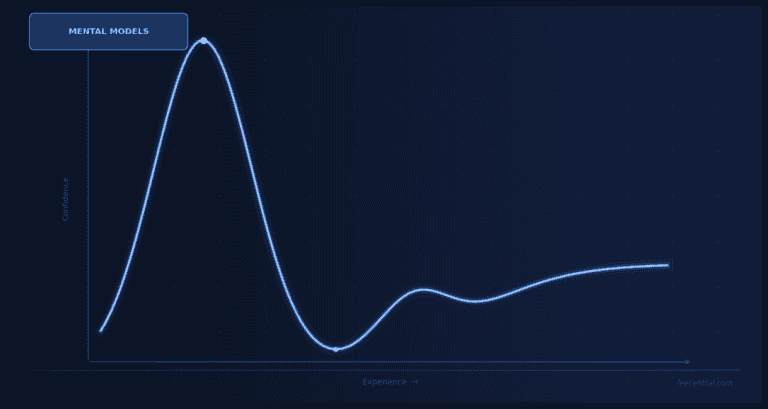
“People will choose the path of least resistance in any system.”
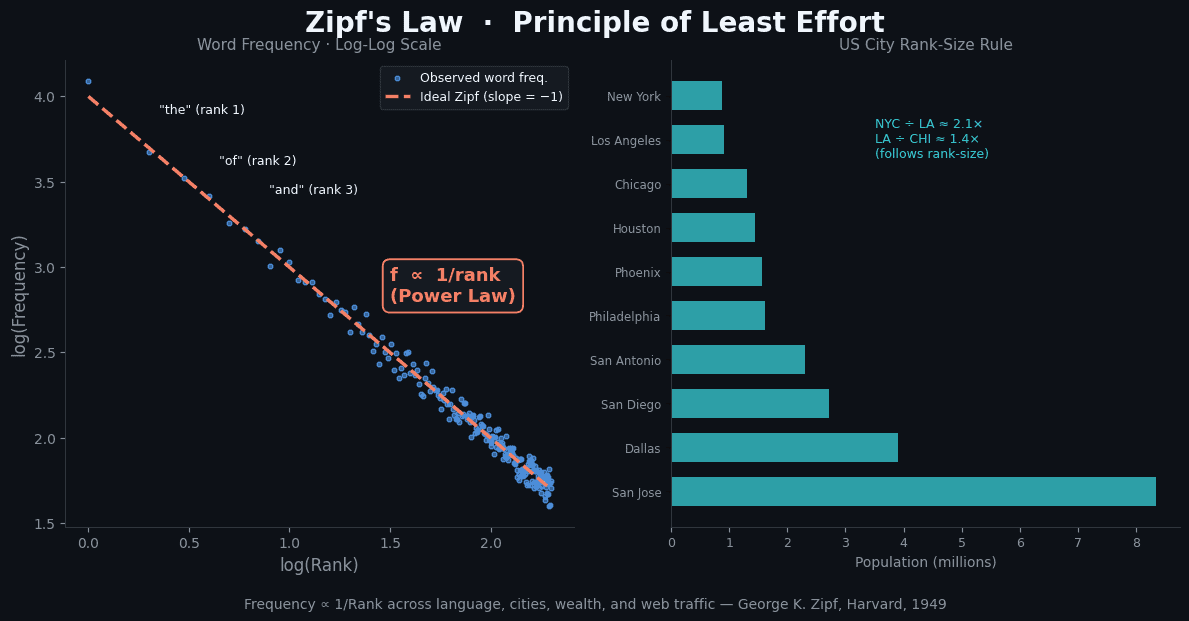
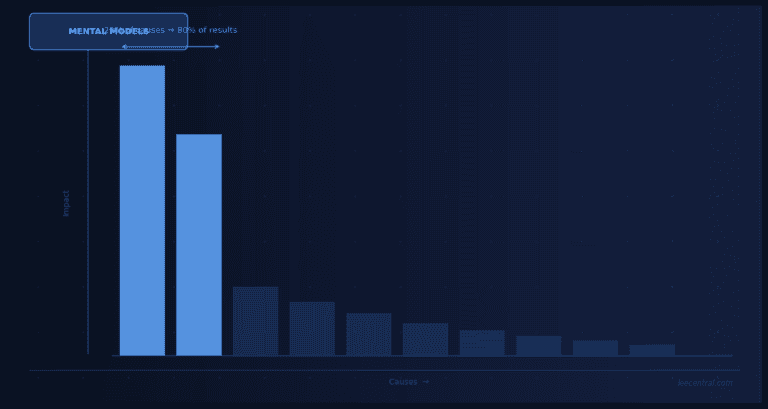
Harvard linguist George Kingsley Zipf spent years counting words in texts and noticed something eerie: in any large body of text, the frequency of any word is roughly inversely proportional to its rank. The most common word appears about twice as often as the second most common, three times as often as the third, and so on. In English, “the” dominates at rank 1. “Of” follows at rank 2, with roughly half the frequency. The pattern holds in French, German, Chinese, and even Esperanto — a constructed language with no native speakers.
Zipf’s explanation was behavioral: both speakers and listeners seek to minimize effort. Speakers prefer shorter, reusable words; listeners prefer predictable, familiar ones. The language that emerges is one that satisfies both constraints — with a small set of high-frequency words doing most of the heavy lifting.
Where You’ll See It
- Language itself: The top 100 most common words account for about 50% of all words used in everyday English. You can write almost anything with a small, overworked vocabulary — and we do.
- City sizes: Rank US cities by population and the pattern holds: New York (rank 1) has roughly twice the population of Los Angeles (rank 2), about three times that of Chicago (rank 3). This rank-size rule appears in nearly every developed country’s urban geography.
- Website traffic: A small number of websites capture the vast majority of internet traffic. The distribution of visits, followers, and engagement across platforms follows a Zipf-like power law — a few wins enormous, most wins nothing.
- UX design: Users overwhelmingly choose the most obvious interface path, not the most powerful one. Features buried two menus deep are functionally invisible, regardless of their utility.
- Income distribution: Individual income follows a Zipf-like distribution — the gap between the top earner and the second is proportionally similar to the gap between second and third, all the way down the distribution.
If you want people to do something — use a feature, follow a process, read a document — put it on the path of least resistance. Friction is not neutral. Every additional step, click, or decision point shrinks engagement exponentially.
Here’s the part that keeps researchers up at night: Zipf’s Law applies even to completely random text generated by a monkey banging on a keyboard. This raises a genuine philosophical puzzle — is the law revealing something about human communication efficiency, or is it simply what any sufficiently random system looks like when you rank it? Decades of research later, there is still no fully settled answer. The distribution is universal. The explanation isn’t.
Further Reading
-
Zipf’s Law — Wikipedia
Free
— Full treatment of the mathematical formulation, linguistic applications, city size distributions, and controversies. -
The Concise Guide to Zipf’s Law — Statology
Free
— Clean statistical explanation with real-world examples and Python code to visualize the distribution. -
Zipf, Power-Law, Pareto: A Ranking Tutorial — University of Wisconsin
Free
— Academic tutorial unifying Zipf’s Law, power laws, and the Pareto distribution under one mathematical framework. -
Zipf’s Word Frequency Law in Natural Language: A Critical Review — PMC
Paper
— Peer-reviewed analysis of the law’s validity, scope, and limitations; free via PubMed Central. -
Human Behavior and the Principle of Least Effort by George K. Zipf (1949)
Book
— The original book that unified word frequency, city sizes, and behavioral economics under one principle.