“People with limited knowledge in a domain overestimate their own competence — because the same skills needed to be good at something are the skills needed to recognize you’re not.”
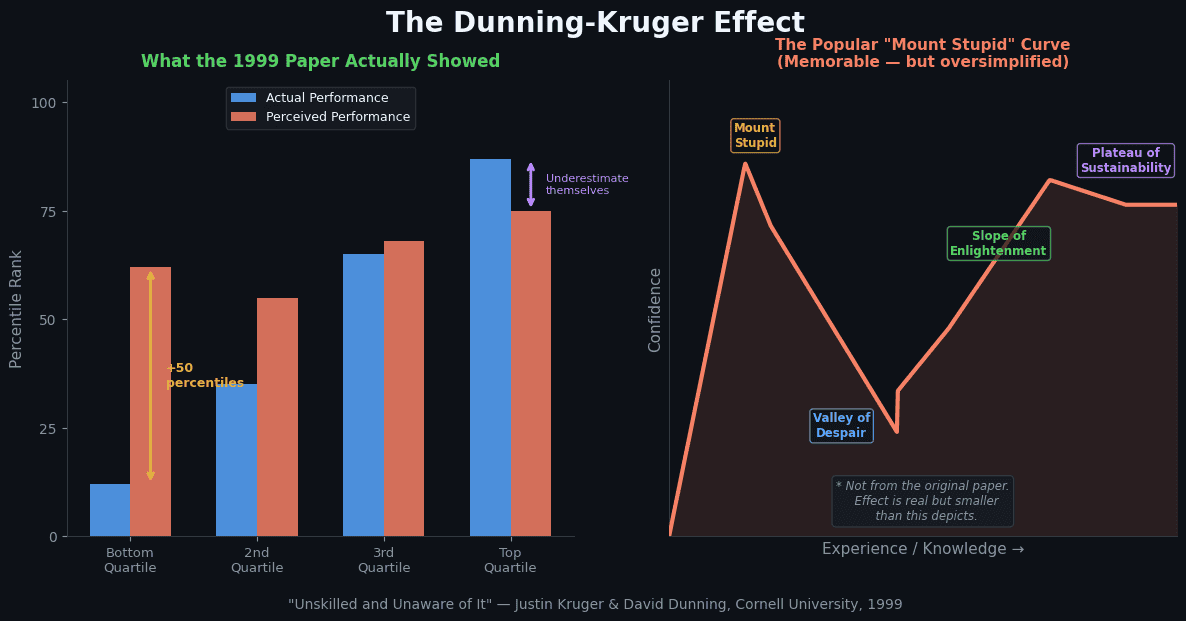
In 1999, Cornell psychologists Justin Kruger and David Dunning ran a series of tests on undergraduate students — measuring actual performance in logical reasoning, English grammar, and humor — and then asked participants to estimate how well they’d done relative to their peers. The results were striking. Students who scored in the bottom quartile didn’t just perform poorly; they estimated themselves to be significantly above average, placing themselves around the 62nd percentile when they’d actually performed at the 12th.
Their explanation was pointed: the same competence that helps you perform a skill also helps you recognize when you’re performing it poorly. Without the skill, you’re also missing the lens to evaluate the skill. Incompetence, in other words, hides itself.
The smooth “Mount Stupid” curve you’ve seen on the internet — with its dramatic peak of confidence for beginners — is not from the original 1999 paper. The actual study used four quartile data points, not a continuous curve. Recent research (Gignac & Zajenkowski, 2020) also suggests the effect may be smaller than popularized, and applies to roughly 5–6% of low performers rather than being universal. The core insight is real. The meme version is an oversimplification — which is, frankly, a fitting irony.
Where You’ll See It
- Medicine: Studies of surgical trainees show that the lowest-performing surgeons are most likely to rate their procedural accuracy highly — before experience-based feedback recalibrates their self-assessment. Junior physicians routinely place themselves 30–40 percentile ranks higher than peer evaluations would suggest.
- Investment and trading: During market booms, individuals with no financial background confidently take concentrated positions, certain their analysis is sound. The experience of a significant loss is often the first real feedback they receive about what they didn’t understand.
- Software development: Junior developers frequently propose architectural overhauls or security solutions with full confidence — missing edge cases, performance implications, and vulnerability patterns that experienced engineers would immediately flag. The gap is invisible precisely because identifying the gap requires the expertise that’s absent.
- Political and scientific opinions: Research has documented that individuals with minimal background in epidemiology, climate science, or economics often express the most certain positions — while domain experts are typically far more calibrated and hedged in their views.
- The Fyre Festival: Billy McFarland organized, sold, and promoted a massive music festival with none of the operational knowledge required to execute it — and apparently no awareness of that gap until it became a catastrophic, internationally documented failure.
The Dunning-Kruger effect is not just a story about other people being overconfident. It’s a structural feature of skill acquisition: the less you know, the less you know that you don’t know. Expertise and calibrated self-assessment develop together. You can’t shortcut one without the other.
The Flip Side: Experts Undersell Themselves
The original data revealed something equally important about the top quartile: they underestimated their performance. People who genuinely excel tend to assume their peers find things just as easy, and therefore rank themselves lower than their actual standing. This is sometimes called the “impostor syndrome adjacent” finding — high performers consistently second-guess themselves in ways low performers simply don’t.
Accurate self-knowledge, it turns out, is rare at both ends. The overconfident novice and the self-doubting expert are mirror failures of metacognition — and both benefit from the same antidote.
The original paper’s root diagnosis was a failure of metacognition — the ability to think about your own thinking. The good news from follow-up research: metacognitive ability can be trained. People who regularly practice honest self-assessment do become more accurate over time.
Make these habits non-negotiable:
- Predict, then compare. Before a presentation, exam, or project review, write down what you think will go well and what won’t. Afterward, read it back. The gap between prediction and reality is your metacognitive calibration data.
- Seek feedback from people who will tell you the truth. Not validation — actual calibration. Find someone with genuine expertise in the domain and ask what they’d do differently.
- Study how experts frame uncertainty. Experts don’t say “I know this.” They say “the evidence suggests,” “in my experience,” “assuming X holds.” Notice that language and ask whyThey use it.
- Treat confident feelings as a signal to slow down. High confidence is not evidence of competence. When you feel most certain, that’s exactly the moment to ask: what would I need to know to find out I’m wrong?
- Keep a “what I got wrong” log. Not to punish yourself — but because patterns in your errors reveal the shape of your blind spots.
The researchers themselves found that as students improved their actual skills in logical reasoning, their self-assessments became more accurate simultaneously. You can’t just think your way to calibration — you have to build real competence alongside the habit of examining it.
The entire research program was inspired by a real news story. In 1995, a Pittsburgh man named McArthur Wheeler robbed two banks in broad daylight with no disguise — then expressed genuine shock when police showed him the surveillance footage. His reasoning: he’d rubbed his face with lemon juice, believing it would render him invisible to cameras (since lemon juice can be used as invisible ink). Dunning read about this in the newspaper, showed it to his graduate student Kruger, and asked: how does someone become that wrong about something that directly? The answer became one of the most cited papers in social psychology.
Further Reading
-
Unskilled and Unaware of It — Kruger & Dunning, 1999 (PubMed)
Paper
— The original paper. Abstract and full citation accessible free; full text via academic library. -
A Brief Guide to the Dunning-Kruger Effect — David Dunning’s Lab, University of Michigan
Free
— Written by Dunning himself. Clarifies common misconceptions and describes the actual findings accurately. -
The Dunning-Kruger Effect and Its Discontents — British Psychological Society
The Dunning-Kruger Effect Is Probably Not Real — McGill University OSS
Free
— Critical examination of the statistical concerns; important for understanding why the popular version overstates the effect. -
Dunning-Kruger Effect — The Decision Lab
Free
— Comprehensive, well-sourced overview covering the original study, real-world examples, related biases, and practical debiasing strategies.