“In a hierarchy, every employee tends to rise to their level of incompetence.”
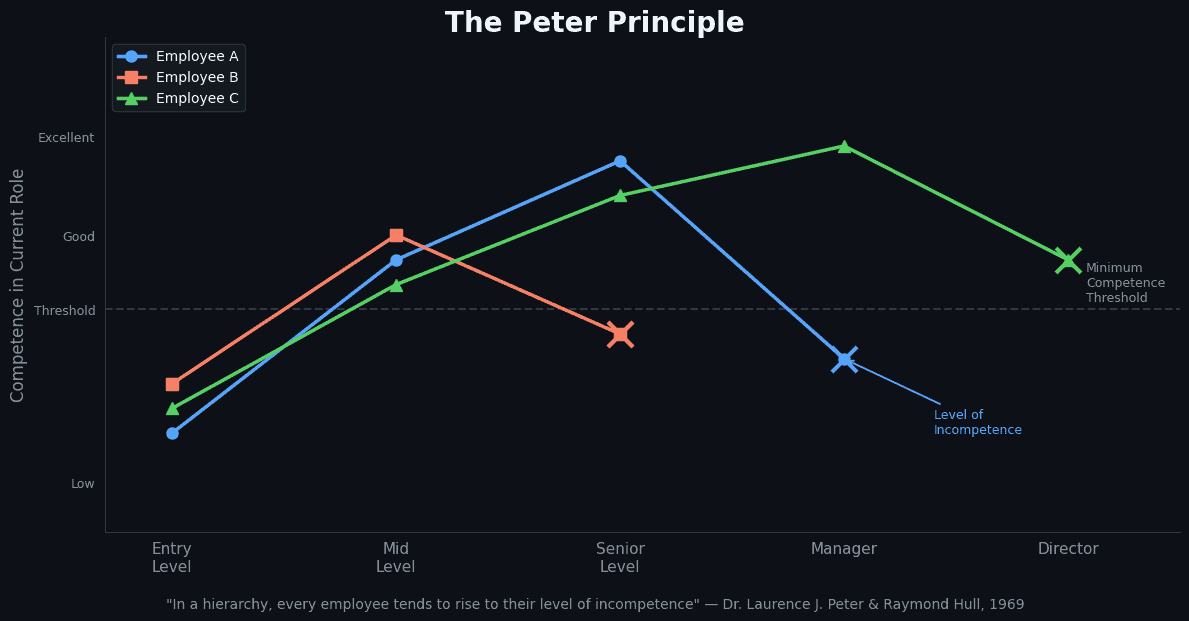
The logic of promotion systems is seemingly obvious: reward good performance with advancement. The problem, as Dr. Laurence Peter and Raymond Hull articulated in their 1969 book, is that doing a job well and doing the next job well are often completely different skill sets. A promotion system that rewards performance at level N systematically fills level N+1 with people optimized for level N.
The full corollary: “In time, every post tends to be occupied by an employee who is incompetent to carry out its duties.” It sounds cynical. It’s more accurately just arithmetical. The promotion stops when you fail. So every successful climber eventually fails — and stays there.
Where You’ll See It
- Sales to management: A 2018 study of 53,000+ salespeople across 214 companies found that top salespeople were most likely to be promoted to management — where they frequently underperformed, because managing humans requires entirely different skills than closing deals.
- Engineering: The brilliant software engineer who’s promoted to engineering manager now spends their days in HR conversations, quarterly planning, and stakeholder decks. The code was the easy part.
- Education: An exceptional classroom teacher becomes a competent assistant principal, then an overwhelmed principal struggling with budgeting, union negotiations, and district politics.
- Military: A decorated field officer whose instincts are tactical gets promoted into strategic planning roles requiring bureaucratic navigation and political savvy — a different war entirely.
- Academia: The researcher with a brilliant publication record becomes department chair, where the job is fundraising, committee management, and faculty mediations. The CV got them there; the CV doesn’t help once they’ve arrived.
Promotions should test for the target role’s skills, not just reward success in the current one. Organizations that confuse “excellent at this job” with “ready for the next one” manufacture their own incompetent management layer.
Like Parkinson’s Law, the Peter Principle was written as satire — and like Parkinson’s Law, it was immediately embraced as serious management theory. Laurence Peter was a schoolteacher for over two decades before becoming an education professor. He had lived the principle before he named it.
Further Reading
-
The Peter Principle: Why Things Always Go Wrong by Laurence J. Peter & Raymond Hull (1969)
Book
— The original. Satirical, quick-reading, and still uncomfortably accurate 55 years later. -
Peter Principle — Wikipedia
Free
— Overview plus links to academic research, criticisms, and the 2018 empirical validation study. -
Research: Do People Really Get Promoted to Their Level of Incompetence? — HBR
Free
— Coverage of the landmark 2018 Benson, Li & Shue study of 53,035 salespeople that empirically confirmed the principle. -
The Peter Principle — Corporate Finance Institute
Free
— Management-focused overview with organizational strategies for counteracting the effect. -
The Peter Principle Revisited: An Agent-Based Model (2024) — arXiv
Paper
— Recent computational modeling study validating and extending the principle; free preprint.