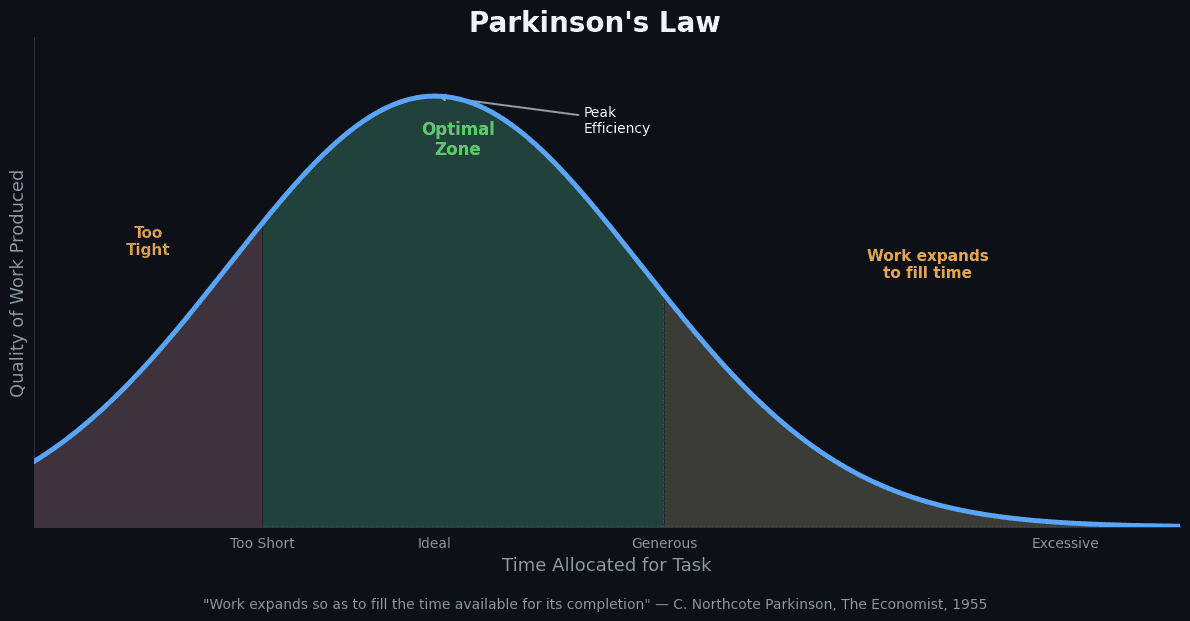
“Work expands so as to fill the time available for its completion.”
C. Northcote Parkinson was a British naval historian who, after years of watching bureaucracies in action, noticed something deeply absurd: organizations tend to grow regardless of how much — or how little — actual work needs doing. He published his observations in a satirical essay in The Economist, and the piece hit a nerve with anyone who had ever watched a two-hour meeting stretch to accommodate a four-hour calendar block.
The core insight: give someone a week to do a two-day task, and the task will quietly expand — gaining complexity, sub-tasks, extra review rounds, and unnecessary polish — until it fills the week. The work doesn’t literally multiply; the effort does. We unconsciously pace ourselves to the deadline.
Where You’ll See It
- Project management: A task assigned a one-week deadline will consume the full week, even if the actual work could be done in two focused days. Scope and deliberation inflate to match the runway.
- Government bureaucracy: Between 1914 and 1928, the British Admiralty lost about 68% of its capital ships and 32% of its sailors — yet Admiralty officials grew by 78% over the same period (roughly 4.3% per year). Parkinson used this as Exhibit A.
- Meetings: A 90-minute meeting slot fills with 90 minutes of discussion. A 30-minute slot covers the same agenda. The duration of the meeting is often set before the agenda is.
- Freelance work: A freelancer given a relaxed deadline tends to start later and finish just in time, regardless of the actual complexity of the work.
- College assignments: Students with a month-long deadline rarely submit work that took a month. Most of it happens in the final 72 hours.
Artificial time pressure is a legitimate productivity tool. If you set tighter deadlines than the work strictly requires, you’ll often get the same result faster — and with less unnecessary embellishment.
Parkinson wrote this as pure satire, deliberately published two days after a government report on civil service inefficiency. The article was meant to mock bureaucracy — not to become a management theory. It became both. The 1958 book it spawned, Parkinson’s Law: The Pursuit of Progress, was a bestseller despite (or perhaps because of) its thoroughly comedic tone.
Further Reading
-
Parkinson’s Law — Wikipedia
Free
— Covers the original essay, historical context, and the secondary principle about bureaucratic growth. -
Parkinson’s Law: The Pursuit of Progress — Internet Archive
Free
— Free digital access to Parkinson’s 1958 book in its entirety. Short, sharp, and surprisingly funny. -
Parkinson’s Law: The Pursuit of Progress by C. Northcote Parkinson (1958)
Book
— Ten satirical essays on organizational behavior. The original and still the best. -
Parkinson’s Law — Asana
Free
— Modern project management perspective on applying the law to team deadlines and sprint planning. -
Parkinson’s Law — Farnam Street
Free
— Detailed mental model analysis with strategies for using the law intentionally.