“When a measure becomes a target, it ceases to be a good measure.”
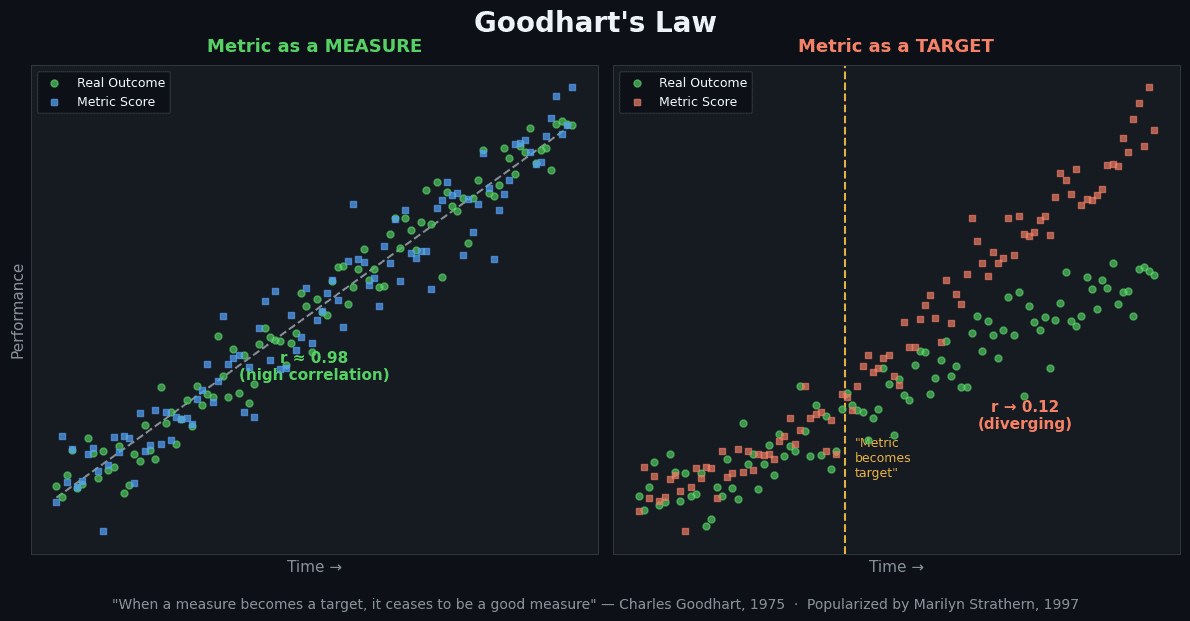
British economist Charles Goodhart originally made this observation about monetary policy in 1975: statistical regularities that look reliable in descriptive data tend to fall apart once policymakers try to control them. He was writing about money supply targets — but the insight turned out to have legs far beyond central banking.
The mechanism is simple and brutal: once you tell people they’ll be evaluated on a metric, they optimize for the metric — often at the expense of the underlying goal the metric was supposed to proxy. The measure was a useful signal. The moment it becomes a target, everyone starts gaming it, and the signal degrades.
Where You’ll See It
- Education: When standardized test scores become the primary accountability metric, schools shift resources toward test prep and away from subjects not on the test. Scores may rise while actual learning stagnates or narrows.
- Healthcare: Hospitals incentivized to reduce average length-of-stay discharge patients earlier — sometimes prematurely — increasing readmission rates. The metric improved; outcomes didn’t necessarily.
- Academic publishing: When institutions reward faculty based on publication count and journal impact factors, researchers split studies into the smallest publishable pieces (“salami slicing”) and chase prestigious outlets over meaningful questions.
- Soviet manufacturing (a classic): A nail factory given a target for number of nails produced thousands of useless miniature nails. Target shifted to weight — the factory produced one enormous, equally useless nail. Both “succeeded.”
- Call centers: When reps are evaluated on average call duration, they rush customers off the line rather than solving problems fully — driving repeat calls and frustration while the metric looks great.
Metrics are proxies, not goals. When the proxy becomes the goal, the proxy breaks. The fix is rarely a better metric — it’s a more honest conversation about what you actually care about and why.
The famous phrasing — “when a measure becomes a target, it ceases to be a good measure” — was actually written by anthropologist Marilyn Strathern in 1997, not by Goodhart himself. She applied his economic observation to academic performance metrics in British universities, and her formulation became the version everyone quotes. So the most-cited version of Goodhart’s Law was written by someone other than Goodhart. The law, applied to itself, checks out.
Further Reading
-
Goodhart’s Law — Wikipedia
Free
— Covers the original formulation, Strathern’s popular phrasing, Campbell’s Law variant, and examples across fields. -
Goodhart’s Law: Causal Diagrams — LessWrong
Free
— Technical decomposition into four distinct failure modes (Regressional, Extremal, Causal, Adversarial Goodhart). -
What is Goodhart’s Law? — Splunk
Free
— Data science and metrics perspective; useful for teams building KPI frameworks. -
Goodhart’s Law — ModelThinkers
Free
— Mental model framing with practical applications to organizational design and performance management. -
“Problems of Monetary Management: The U.K. Experience” by Charles Goodhart (1975)
Paper
— The original paper (available through academic databases). Read to see the law in its original monetary policy context.