
“80% of consequences come from 20% of causes.”
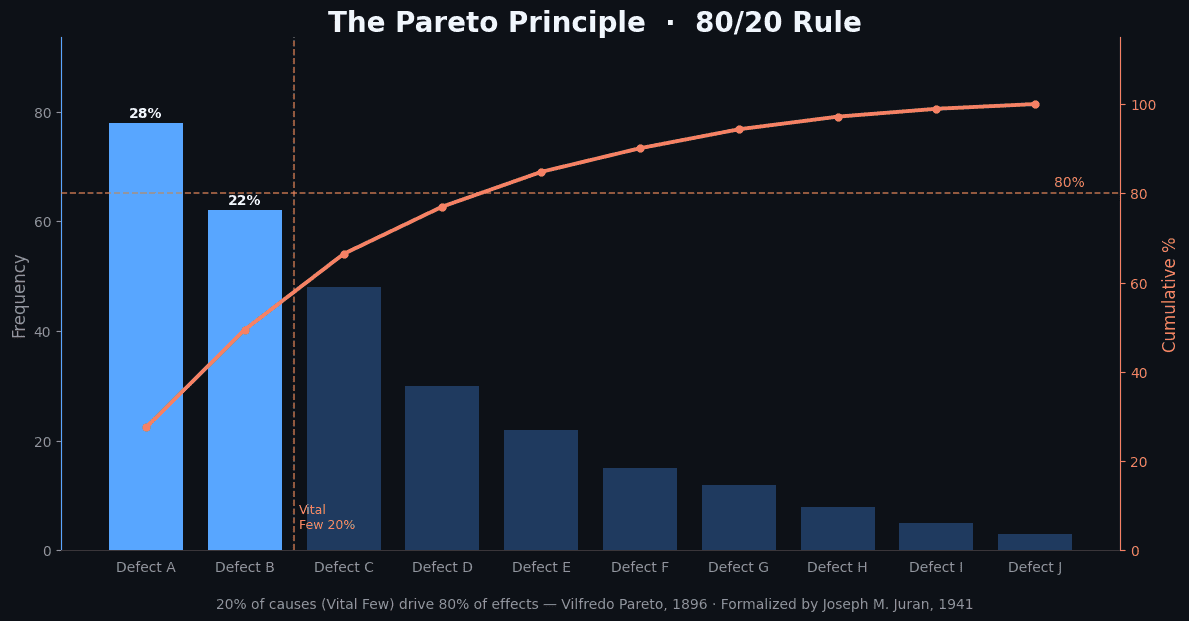
In 1896, Italian economist Vilfredo Pareto noticed something odd in his garden: roughly 20% of his pea pods produced about 80% of the peas. Curious, he ran the same lens over Italian land ownership and found the same lopsided pattern — 20% of the people owned 80% of the land. A quirk, or something deeper?
Decades later, quality management pioneer Joseph Juran noticed the same imbalance showing up everywhere in business. He named it the Pareto Principle and applied it to defect analysis: fix the top 20% of bugs and you eliminate 80% of the crashes. The principle stuck — not because it’s mathematically exact (it’s not), but because the underlying asymmetry is genuinely universal.
Where You’ll See It
- Software: Microsoft’s research found that fixing the top 20% of most-reported bugs eliminated 80% of related crashes and errors in Windows.
- Sales: In most businesses, 20% of customers generate roughly 80% of revenue. Your best clients disproportionately keep the lights on.
- Sports: In most team sports, the top 20% of players account for around 80% of the scoring output. The same ratio appears in individual stats across leagues.
- Crime: Criminological studies consistently find that roughly 20% of offenders are responsible for approximately 80% of criminal acts in a given population.
- Inventory: In retail, about 20% of SKUs generate 80% of sales. The rest is shelf filler — helpful for selection, but not the engine of the business.
Before you spread effort evenly, ask: which 20% of inputs are doing the heavy lifting? Identify the vital few, double down on them, and stop pouring energy into the trivial many.
Juran, who popularized the term, actually preferred not to call it the “80/20 rule” — he worried people would dismiss the remaining 80% of causes as worthless. He coined “vital few and useful many” instead. The 80/20 framing won anyway, proving that even branding follows the Pareto Principle.
Further Reading
-
Pareto Principle — Wikipedia
Free
— Comprehensive overview with mathematical foundations, history, and applications across disciplines. -
Guide to the Pareto Principle — Juran Institute
Free
— From the organization founded by Joseph Juran himself; covers Pareto analysis in quality management. -
Pareto Analysis — ASQ (American Society for Quality)
Free
— Practical how-to for applying Pareto charts in process improvement and defect analysis. -
The 80/20 Principle by Richard Koch (1997)
Book
— The definitive modern treatment of applying the principle to business and personal productivity. -
The 80/20 Rule — Farnam Street
Free
— Well-contextualized mental model writeup covering the principle’s implications for decision-making.