“Beyond a certain point, each additional unit of input yields less and less output.”
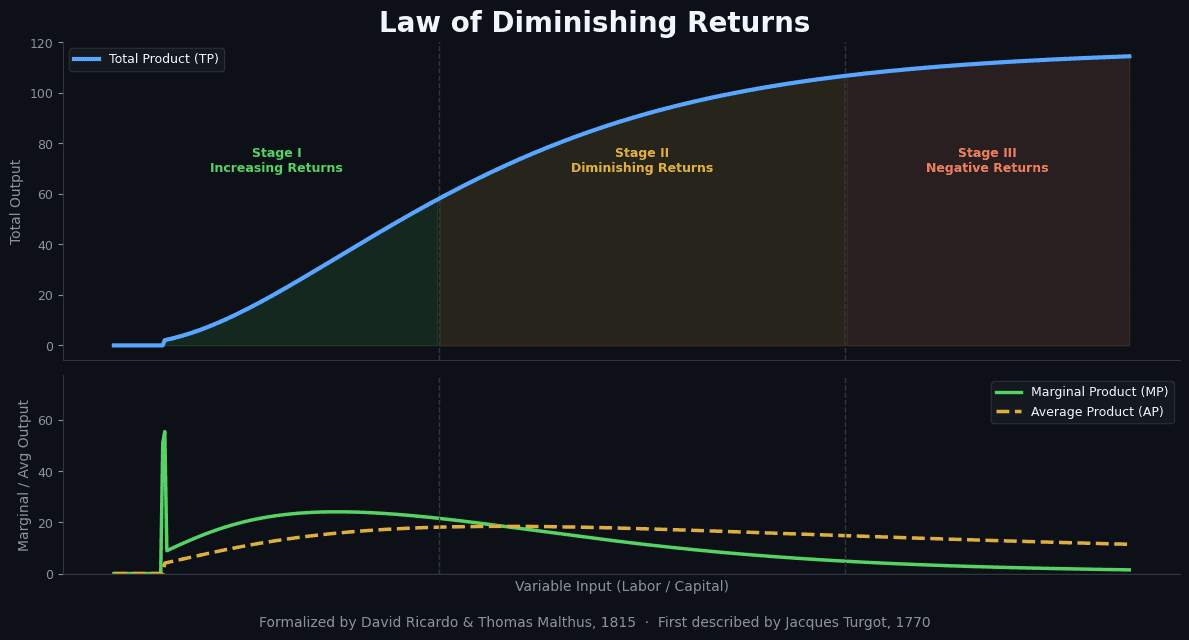
French economist Jacques Turgot first put the idea into words in 1770: each added increment of input produces a smaller and smaller increase in output. Forty-five years later, with Britain’s Corn Laws under debate and the Napoleonic Wars forcing farmers to cultivate increasingly marginal land, economists David Ricardo and Thomas Malthus formalized the concept. Watching lower-quality land produce less crop per worker made the principle impossible to ignore.
The mechanics are straightforward: some resources are fixed (land, time, a human brain), and stacking more of a variable input on top of a fixed one eventually runs into a ceiling. The first unit of effort is the most productive. The hundredth? Much less so.
Where You’ll See It
- Studying: The first two hours of exam prep are genuinely transformative. Hours seven and eight? You’re mostly rereading sentences while increasingly resentful of your highlighter.
- Agriculture: Adding workers to a fixed plot of land increases yield — up to a point. Stack too many people on the same acre and they start bumping into each other.
- Marketing spend: The first $10K in ad spend might return $50K in revenue. Doubling that spend rarely doubles the return — audiences saturate, costs rise, and marginal effectiveness falls.
- Medicine: An initial dose of most medications provides significant therapeutic benefit. Triple that dose and you’re more likely to hit side effects than a proportionally tripled benefit.
- Exercise: Going from zero training to five hours per week produces dramatic fitness improvements. Going from 15 to 20 hours delivers much smaller gains while substantially increasing injury risk.
More is not always better — it’s sometimes just more. Before adding resources, effort, or investment, ask whether you’ve already crossed the point of diminishing returns. The ceiling is real, and identifying it early is a competitive advantage.
The Corn Laws crisis that crystallized this principle is a classic example of historical events driving economic theory rather than the reverse. Wartime necessity forced farmers onto bad land; bad land made the principle visible; visible principles get formalized. Ricardo and Malthus didn’t invent the idea — reality shoved it in front of them.
Further Reading
-
Diminishing Returns — Wikipedia
Free
— Full economic treatment including historical development, formal definition, and the TP/AP/MP curve framework. -
Law of Diminishing Marginal Returns — Economics Help
Free
— Clear diagrams and worked examples; excellent starting point for non-economists. -
Law of Diminishing Returns — Economics Online
Free
— Definitions, stages of production, and illustrative examples with the standard three-stage diagram. -
Principles of Economics by N. Gregory Mankiw (any recent edition)
Book
— The standard university economics textbook; Chapter on production and costs covers this law in full technical detail. -
Law of Diminishing Marginal Returns — Investopedia
Free
— Business-focused explanation with financial and investment examples.